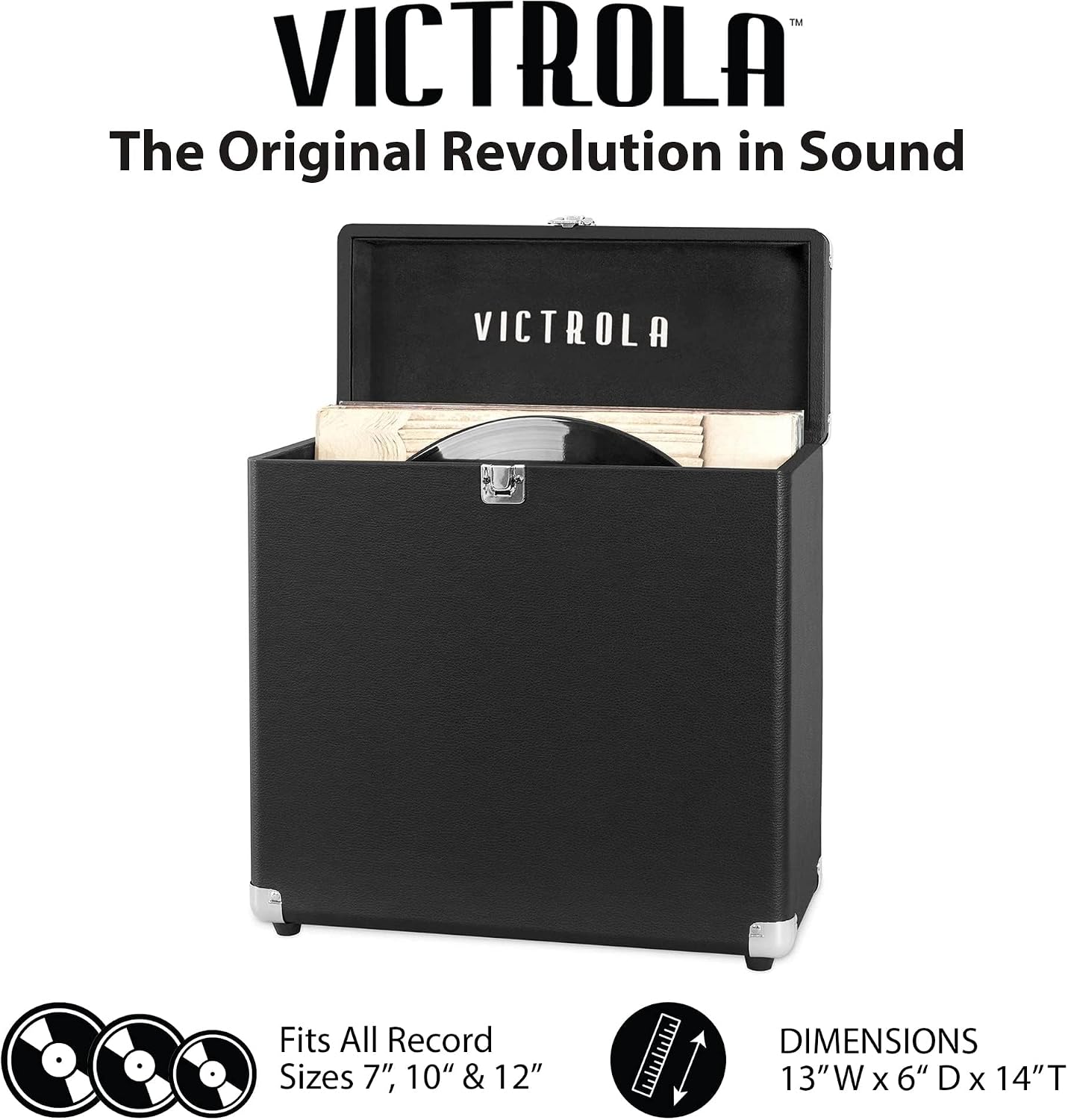
If you own vinyl records — those large, grooved discs that play music on a turntable — you already know they’re not exactly backpack-friendly. A standard 12-inch LP (the most common album format, about 12 inches square and roughly 140–180 grams of PVC plastic) is rigid, heavy in bulk, and remarkably easy to warp, crack, or scratch if transported carelessly. Most storage advice assumes your records are staying put in a permanent shelf or cube unit at home. But real collectors move: between apartments, to listening sessions at a friend’s place, to record fairs, to storage units when life gets complicated. This guide is for that situation — the moment when your collection stops being a static display and becomes something you need to physically carry without destroying what you’ve spent years (and hundreds of dollars) building.
What follows is a comparison-focused breakdown of the main portable storage categories, the tradeoffs that matter when you’re mid-decision, and a clear decision framework at the end so you can stop second-guessing and start packing.
The Four Categories (and Where They Actually Fail)
The market for portable vinyl storage splits into roughly four product families. Understanding where each one breaks down is more useful than any manufacturer’s pitch.
1. Soft-Shell DJ Cases (Zippered Bag Format)
These are padded, zippered bags — usually nylon or canvas — designed originally for DJs who carry 30–60 records to a gig. Brands like Technics, Odyssey, and Gator produce well-documented versions. The interior is typically foam-lined or padded, with a spine divider to keep records upright, and most include a shoulder strap.
The tradeoff: Soft cases protect well against incidental bumps and dust. They are light and genuinely portable. But the protection ceiling is low. If another passenger sits on it in a van, if the bag tips over in a trunk, or if records are packed too loosely and slide laterally, you’re looking at bent corners on sleeves and — in worst cases — cracked jackets. The Vinyl Factory’s storage guidance notes that lateral shifting is one of the most common transit-damage culprits, something soft cases mitigate poorly when under-packed. These are optimized for carrying a curated selection of 30–60 records on a short trip, not 200 LPs during a cross-city move.
Who it’s for: Anyone regularly taking 20–60 records to a listening session, a DJ set, or a record fair where you’re pulling from your own stock for same-day listening. Not a moving solution.
2. Hard-Shell Cases (Latched Enclosures)
Hard-shell cases — produced by brands including Odyssey, Gorilla, and (at the higher end) SKB — are injection-molded or roto-molded ABS plastic or polyethylene shells with foam interiors and metal latches. They’re the same basic technology used to ship camera gear and instruments. Analog Planet’s transport coverage consistently points to the hard-shell format as the only category that provides meaningful shock and compression protection when records are placed in cargo holds, van floors, or storage stacks.
The tradeoff: Weight and cost. A quality hard-shell case rated for 50–75 LPs can run $80–$200 and weighs 8–14 lbs empty. At capacity, you’re managing 25–35 lbs — meaningful if you’re also carrying a turntable. Corner impact protection is real; vertical compression from stacked boxes in a moving truck is where even hard shells have limits. Reviewers consistently note that records should always be packed spine-up and tight enough to prevent lateral movement — foam inserts or folded moving blankets fill the gap when you’re under capacity.
Who it’s for: The collector moving a curated 50–100 record subset of a larger collection — the records you’d genuinely grieve if they warped or cracked. Also correct for anyone flying with records in checked luggage, though you should always check individual airline dimension and weight policies before committing to a hard case for air travel.
3. Wooden Crates and Cube Inserts (The Classic Format)
The milk-crate aesthetic has been part of record culture since the 1970s. Purpose-built wooden crates — either open-slatted like the classic oak milk-crate style or solid-panel versions from brands like Vinyl Styl or custom woodworkers — hold roughly 50–75 LPs and stack. They’re also, per Pitchfork’s coverage of vinyl collecting culture’s expansion into lifestyle product categories, the format most likely to double as home furniture between moves.
The tradeoff: Wooden crates are structurally excellent for keeping records vertical and stable. They offer zero padding. A dropped crate transfers the full impact to the stack. They’re also heavy — a solid wood crate filled with 60 LPs can approach 40 lbs — and have no integrated carry handles rated for that load. Owners consistently report that handles are the first failure point; the hardware matters as much as the wood itself.
The specific use case where wood wins: Short-distance vehicle transport where you control the loading and unloading yourself. Driving your collection from one apartment to another in your own car, where you’re placing crates in the trunk and back seat and can confirm they won’t tip. Do not use these in moving trucks where someone else is stacking boxes on top.
4. Cardboard Moving Boxes (Specialized LP Format)
Uline, Bags Unlimited, and similar packaging suppliers sell boxes specifically dimensioned for LP storage — typically 13”x13”x13” or adjustable-depth versions that hold 50–100 records depending on the configuration. These are not generic cardboard boxes; they’re single-wall or double-wall corrugated stock cut to fit records without the lateral slop that destroys jackets in undersized boxes.
The tradeoff: The cheapest option by a significant margin, but the most contingent on packing discipline. Highsnobiety’s coverage of vinyl as a lifestyle category notes that the culture now treats records as appreciating artifacts — and appreciating artifacts deserve more than naked cardboard if there’s any moisture risk, any distance, or any cargo loading by people who don’t share your anxiety about the collection.
When cardboard works: Full-collection moves where you’re doing your own packing, using fresh double-wall LP boxes (never reused boxes with soft corners), packing records tight with zero lateral play, marking every box TOP LOAD ONLY in large font, and managing the load yourself. For a 300–800 LP collection moving 5 miles, purpose-spec LP boxes are a defensible choice at roughly $1.50–$3.00 per box. For anything in a commercial moving truck or storage facility with unknown stacking conditions, add a layer: hard-shell the irreplaceable, box the bulk.
By the Numbers
| Format | Capacity | Typical Price Range | Shock Protection | Best Case |
|---|---|---|---|---|
| Soft-shell DJ bag | 30–60 LPs | $40–$120 | Low-medium | Local gig / session |
| Hard-shell case | 40–75 LPs | $80–$200 | High | Air travel, cargo, van |
| Wooden crate | 50–75 LPs | $30–$120 | None (zero padding) | Short car haul, display |
| LP-spec cardboard box | 50–100 LPs | $2–$5/box | Low (packing dependent) | Full-collection self-move |
What Actually Damages Records in Transit (And How Storage Choice Maps to Each Risk)
Most transit damage comes from three specific failure modes, not from the dramatic drops collectors imagine.
Lateral shifting. Records that can move sideways within a container will develop bent, split, or compressed jacket corners within a single car trip. The fix is simple — pack tight, use filler material when under-capacity — but it requires active attention. Hard-shell cases with foam inserts manage this passively. Soft bags and cardboard boxes require you to manage it manually.
Vertical compression. A stack of boxes in a moving truck can generate hundreds of pounds of pressure on the bottom box. Standard LP boxes are not rated for significant compression loads. Hard-shell cases with rigid ABS or polyethylene shells transfer that load through the case structure rather than through the records. If your collection is going into a moving truck alongside furniture, the hard-shell tier is not optional for anything irreplaceable.
Heat and humidity. No case protects against a record left in a hot car in summer. Vinyl warps at sustained temperatures above roughly 140°F — a parked car interior in direct sun can exceed that threshold within an hour in warm climates. The Vinyl Factory’s storage guidance is explicit on this: transit is not just about physical protection, it’s about thermal management. Never treat a car as temporary storage between trips.
The Grading Framework: Matching Storage to Collection Value
If you’re sitting on a collection with meaningful financial and cultural value — colored pressings, hand-numbered variants, test pressings, anything you’d list on Discogs at over $50 — the decision framework is straightforward:
Tier 1 (Irreplaceable or high-value records): Hard-shell case, individually sleeved in poly-lined inners, packed spine-up. No exceptions for moves involving commercial trucking, air travel, or any situation where you don’t control the loading.
Tier 2 (Core collection, replaceably valued at $10–$50 per record): LP-spec double-wall cardboard boxes packed tight, top-load only, self-managed haul. Add soft-shell bags for any sub-selection you’re actively pulling out on both ends of the trip.
Tier 3 (Listening copies, beat-up gatefolds, anything you’re not precious about): Whatever you have available. Cardboard, crates, soft bags — discipline in packing matters more than the container at this level.
For regular transport (not moves): Soft-shell DJ bag for your working stack of 30–60 records is the correct default. Upgrade to hard-shell the moment air travel or cargo holds enter the equation.
The Decision Rule
If X is a one-time full-collection move in a self-driven vehicle with no commercial handlers, then Y is LP-spec cardboard boxes (double-wall, purpose-dimensioned), packed tight, with hard-shell cases for your top-tier variants.
If X is recurring transport — weekly listening sessions, record fair sales, DJ sets — then Y is a quality soft-shell bag at 30–50 record capacity, replaced when the padding compresses noticeably.
If X involves any commercial moving service, air cargo, or situations where someone else is stacking and loading, then Y is hard-shell for everything you’d genuinely replace on Discogs. The cost of one cracked original pressing on a Nuclear Blast colored variant or a hand-numbered box set exceeds the price of a quality hard case by a significant margin. The math is not close.
The wooden crate is the right answer specifically when the answer to “do I control this entirely” is yes, and when the answer to “is this going further than my own car” is no. Outside those conditions, it’s furniture, not transport.
Sources referenced: The Vinyl Factory, “How to store your vinyl records properly”; Analog Planet, “The right way to transport your record collection”; Highsnobiety, “Vinyl collecting is officially a lifestyle product category”; Pitchfork, “Why vinyl collecting culture keeps expanding.”