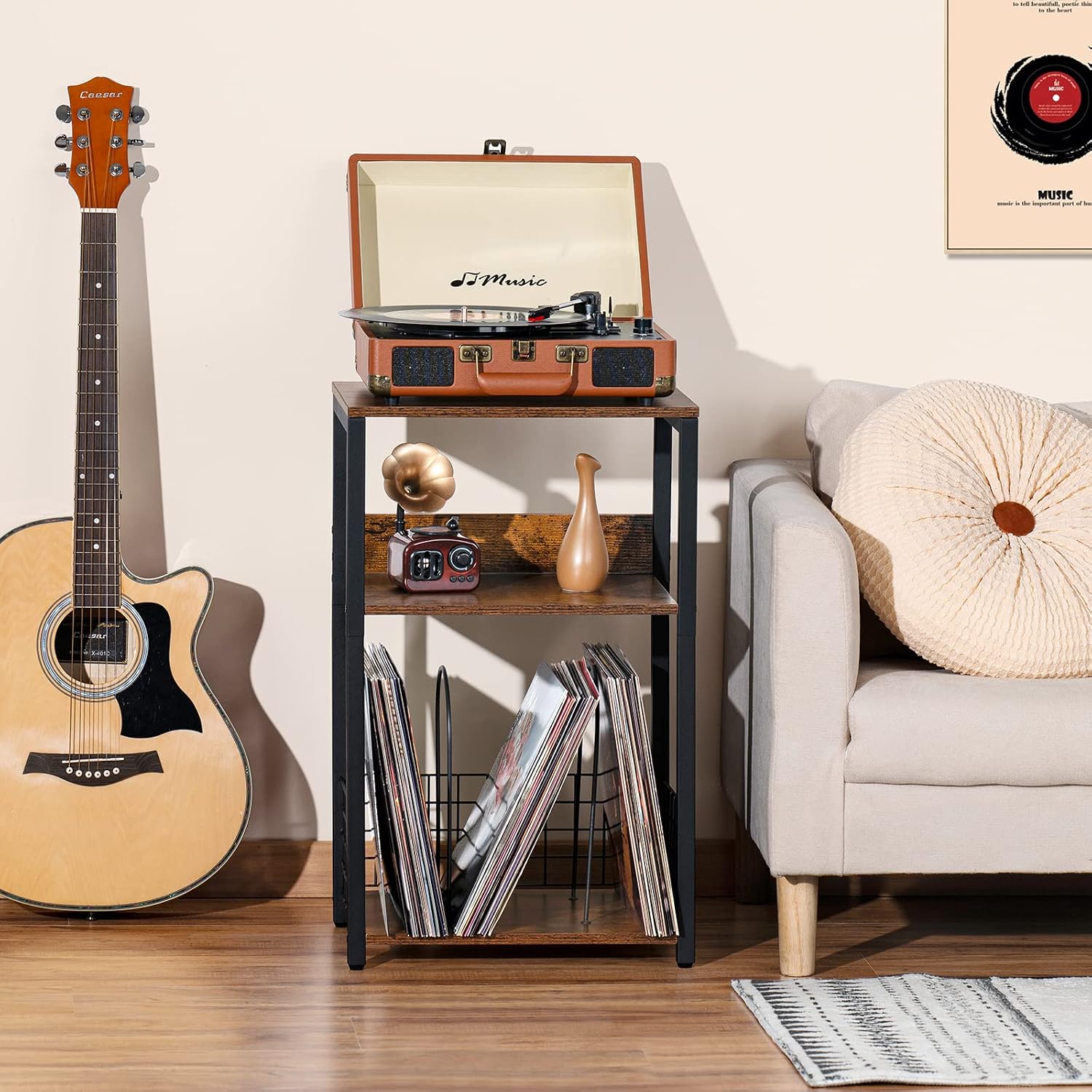
If you’ve been collecting vinyl records for any length of time, you’ve hit the moment: the milk crates are overflowing, the stack next to the turntable is a structural hazard, and you still can’t find your copy of Reign in Blood without excavating half the room. A record player stand with built-in storage is exactly what it sounds like — a piece of furniture designed to hold your turntable (the device that plays vinyl records) on top, with dedicated slots or shelving below to keep your albums organized and upright. Manufacturers frequently market these units with claims like “100-album capacity,” and that number sounds generous until you actually start loading them up with gatefold double-LPs, box sets, and the kinds of over-sized deluxe pressings that extreme metal labels have made a specialty. This guide is for collectors who are past the “buy whatever fits” phase and want to make a genuinely informed decision — one that accounts for the realities of a metal collection specifically, not a generic mix of slim pop singles.
| EDITOR'S PICK[Joaxswe Record Player Stand wit…](https://www.amazon.com/dp/B0CNH1K8BX?tag=greenflower20-20) | Mid-tier3-Tier Vinyl Record Storage: Vi… | Budget pick[LELELINKY 3 Tier End Table](https://www.amazon.com/dp/B0FSSGJ8BF?tag=greenflower20-20) | |
|---|---|---|---|
| Capacity | 200 albums | 450 records | 100 albums |
| Material | Wood | — | — |
| Charging station | ✓ | — | — |
| Adjustable dividers | — | ✓ | — |
| Width | 24" | — | — |
| Price | $99.99 | $85.49 | $30.99 |
| See on Amazon → | See on Amazon → | See on Amazon → |
What “100-Album Capacity” Actually Measures (And Why Metal Collections Compress That Number Fast)
Let’s start with the math manufacturers are using, because it almost certainly isn’t your math.
When a furniture brand states 100-album capacity, they’re typically calculating based on standard single-LP jackets — the thin cardboard sleeves that house a single 12-inch record — stored at roughly 4–5 millimeters per record. At that spacing, 100 records fit into about 45–50 centimeters of internal shelf width with reasonable browsing pressure (not packed so tight you can’t flip through without damaging sleeves).
Metal collections break that formula in at least three common ways:
Gatefold jackets. A standard single LP in a gatefold sleeve — the kind that opens like a book and is used constantly by labels like Nuclear Blast, Century Media, and Relapse Records on anything with artwork ambitions — runs approximately 6–8 mm per record. That single change compresses a “100-album” shelf to a realistic 60–75 record capacity before you’ve added a single insert.
Double and triple LPs. The 2xLP and 3xLP format has become the de facto standard for any metal release over 45 minutes that a label wants to present seriously. A 2xLP in a gatefold with an insert runs 10–14 mm. Run 20 of those through a “100-album” shelf and you’ve consumed 280 mm — more than half a standard 500 mm internal shelf width — on 20 records, not 50.
Box sets and book-format releases. Labels including Earache, Dark Descent, and Season of Mist have increasingly issued limited box sets with hardcover books, multiple discs, and rigid outer shells. These don’t belong in a standard record shelf at all — they need either a separate flat storage zone or a dedicated section with taller clearance.
The Vinyl Factory’s published guidance on proper record storage consistently flags upright storage as the correct method (flat-stacking causes warping over time) and recommends leaving 10–15% of shelf space empty at all times to prevent spine damage during browsing. Factor that in, and a stated 100-album shelf is a practical 60-record shelf for a gatefold-heavy metal collection.
By the numbers:
| Format | Avg. thickness per unit | Realistic count in 500 mm shelf |
|---|---|---|
| Single LP, no gatefold | 4–5 mm | ~100 units |
| Single LP, gatefold | 6–8 mm | ~65 units |
| 2xLP, gatefold + insert | 10–14 mm | ~40 units |
| Box set / hardcover edition | 30–60 mm | ~10–15 units |
Structural Load: Why the Stand’s Weight Rating Matters More Than Its Capacity Rating
Capacity and weight tolerance are two entirely different specifications, and furniture brands lean hard on the first while burying the second. Analog Planet’s turntable setup documentation notes that a mid-range belt-drive turntable (the most common type among intermediate collectors — a motor drives a rubber belt that spins the platter, isolating the platter from motor vibration) typically weighs 4–9 kg on its own. Add a phono preamp (the small box that amplifies the cartridge’s signal to line level so it can connect to speakers or a receiver) and a receiver or integrated amplifier, and the top surface of your stand may be bearing 15–25 kg before a single record goes in the shelf below.
Vinyl itself is dense. A standard LP weighs approximately 130–180 grams; a 180-gram audiophile pressing (the heavier formulation used by most serious reissue programs and premium new releases) hits the top of that range. One hundred records at 150 grams average is 15 kg of vinyl alone. Two hundred records — a modest intermediate collection — is 30 kg in the storage compartment. This is why MDF-based budget furniture (MDF = medium-density fiberboard, a compressed wood composite common in flat-pack furniture) with thin shelving panels and dowel joinery consistently draws negative long-term owner feedback in aggregated reviews. The shelves bow. The side panels rack. The dowels loosen.
Consequence of Sound’s coverage of record storage solutions in mid-decade notes a clear pattern: owners who initially praised budget MDF units at the 50–75 record threshold frequently report visible shelf sag by the time collections reach 120–150 records on the same unit. For a metal collector who’s actively buying colored variant pressings, tour exclusives, and label bundle deals — the kind of purchasing behavior that adds 20–30 LPs per year — that sag timeline is 3–4 years, not a decade.
What to look for in published specs: solid wood or plywood carcass construction (both handle point loads and moisture more reliably than MDF per materials science literature), metal corner reinforcement on mid-range units, and stated per-shelf weight ratings above 20 kg. If a manufacturer doesn’t publish a per-shelf weight rating, treat that as a red flag for load-bearing applications.
Vibration Isolation and Why the Stand’s Material Choice Affects Your Sound
Here’s the tradeoff that most furniture-first buyers miss: a record player stand isn’t just a storage problem, it’s an acoustic coupling problem. A turntable’s needle (more precisely, the stylus on the cartridge) is reading physical grooves in a spinning disc at resolutions measured in microns. Any vibration transmitted through the stand surface into the turntable’s platter or tonearm introduces what’s called feedback or acoustic coupling — a low-frequency rumble or mid-range smear that degrades sound quality, particularly audible with the loud, low-tuned content that defines death metal, doom, and sludge recordings.
Pitchfork’s completist coverage of vinyl playback setups identifies mass-loading and decoupling as the two primary approaches to managing this. Mass-loading means the stand itself is heavy enough to absorb vibrations rather than transmit them — solid hardwood and thick stone-surfaced units perform better here than hollow MDF. Decoupling means placing an isolation device (a rubber mat, a dedicated isolation platform like a Townshend Audio Seismic Pod system, or even a slab of butcher block on rubber feet) between the turntable and the stand surface. The latter approach means your stand choice matters slightly less for acoustic performance — but you’re now spending an additional $80–$200 on an isolation platform that you need to budget into the total cost.
The practical decision frame here: if your listening room has a wooden floor, runs a subwoofer, or is adjacent to a space where people move around, decoupling is worth the investment regardless of what stand you choose. If you’re on a concrete slab in a dedicated listening room and your speakers are stand-mounted away from the turntable stand, a quality mass-loaded hardwood unit without additional isolation is typically sufficient per owner reports across audiophile community discussions compiled by Analog Planet.
The Real Decision: Storage-First or Playback-First?
This is the tradeoff you’re actually making, so let’s name it directly.
Storage-first builds prioritize maximum record capacity, modular expansion, and dust protection. They’re right for the collector whose primary relationship with the collection is archival — the person buying /500 Nuclear War Now! releases, chasing Century Media catalog pressings, and treating the vinyl as cultural artifacts that appreciate in value. These builds typically use dedicated record storage furniture (brands like Kallax from IKEA remain collector-community favorites for their modular scalability and per-cube weight ratings, though they require a separate turntable surface) rather than combined stands, because separation allows you to optimize each element independently.
Playback-first builds prioritize the turntable surface, vibration control, and keeping the full signal chain — turntable, phono preamp, amplifier — on one stable, well-built piece of furniture. Storage is secondary; these builds typically keep a working 50–80 record selection accessible in the stand and house the broader archive in separate shelving or a dedicated record room. This is the right call if you’re actively spinning multiple records per session, running a system you’ve invested $600+ in, and care about the delta between mediocre and good playback quality.
The if/then decision rule:
- If your collection is under 150 records and growing at fewer than 30 per year → a well-built integrated stand (solid wood or plywood, published weight rating above 20 kg per shelf) is the right call. Look for units in the $180–$350 range from brands with documented construction specs.
- If your collection is 150–400 records, includes significant box set and double-LP volume, or is growing fast → separate your storage and playback surfaces. Budget $150–$250 for dedicated modular record storage and $150–$300 for a purpose-built turntable stand with proper mass and decoupling options.
- If you’re archiving 400+ records, buying test pressings, or treating the collection as an investment → integrated furniture was never the right solution. You need dedicated archival shelving with climate awareness, and your turntable deserves a purpose-built stand on a separate footprint.
The “100-album capacity” number on any product listing is a starting point for a conversation, not a specification you can trust at face value. For a metal collection built on gatefolds, double-LPs, and limited pressings, cut that number in half before you start measuring your wall space — and spec the weight rating like your records’ spines depend on it, because over a long enough timeline, they do.