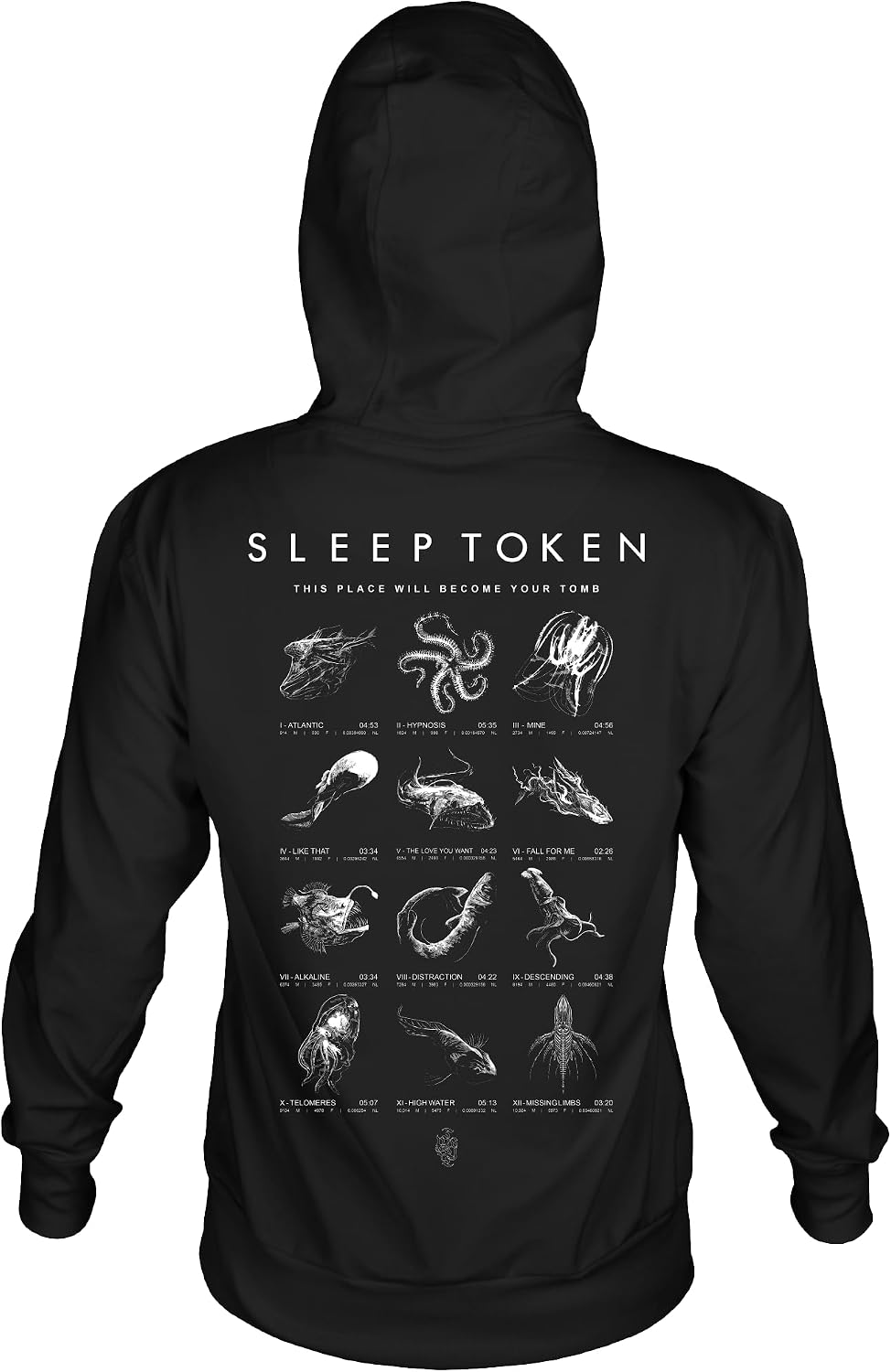
A band hoodie used to be a simple transaction: you stood at the merch table after a sweaty set, handed over cash, and walked away with a screen-printed fleece that would bleed in the wash by December. That era is mostly over — at least at the top end of the market. Today, some of the most commercially interesting pieces in heavy music are hoodies that could sit comfortably in a streetwear boutique window next to labels like Pleasures or Neighborhood. Sleep Token and Linkin Park — two acts whose fanbases overlap almost nowhere in terms of sound, but share a strikingly similar demographic of style-conscious younger buyers — are leading this shift. If you’re already spending $80 to $180 on merch regularly and wondering whether the premium pieces from these artists justify the step up in price, this article is the decision framework you need.
What “Streetwear Crossover” Actually Means in Construction Terms
The phrase gets thrown around loosely, so it’s worth pinning down what it signals about a physical garment before you spend $150 on something you’ve only seen in a product photo.
In streetwear, a hoodie earns premium positioning through a recognizable set of construction signals. French terry refers to a looped-back fabric construction — the interior surface has small loops rather than a brushed finish — which reads as lighter, drapier, and more elevated than the standard budget fleece you’d find on a Gildan blank. GSM (grams per square meter) is the weight measure for fabric: most entry-level band hoodies run 240–270 GSM; garments in the 380–420 GSM range are substantially heavier and hold their shape through repeated washing. Double-needle stitching at stress points — cuffs, hem, sleeve seams — extends longevity and is a standard signal of above-baseline construction. These are the terms manufacturers and boutique buyers use to evaluate blanks before graphics ever touch the fabric.
Why does this matter for band merch specifically? Because Highsnobiety’s reporting on the merch-to-streetwear pipeline has consistently noted that the crossover buyer — the person who follows Supreme drop culture and also goes to shows — evaluates band pieces against streetwear benchmarks, not against other band tees. If a $160 Sleep Token hoodie sits next to a $160 Pleasures hoodie in someone’s consideration set, it’s competing on those construction terms whether the label markets it that way or not.
Sleep Token: The Case Study in Mystique-Driven Merch Pricing
Sleep Token’s merchandise operation has evolved in near-lockstep with the band’s commercial ascent. When Take Me Back to Eden drove the project into mainstream heavy-music consciousness in 2023, the merch strategy shifted from basic screen prints toward limited drops with designed scarcity — numbered runs, single-event exclusives, and pieces that lean into the band’s visual identity of masks, religious iconography, and stark black-and-white contrast.
Kerrang!‘s coverage of the band’s touring cycle noted that Sleep Token merch lines routinely sell out within hours of drop announcements, with secondary market prices on Grailed running 1.5x to 2.5x retail on staple pieces within weeks. That’s a meaningful signal — it tells you demand is real — but it doesn’t automatically mean the construction justifies the retail price before secondary inflation.
Here’s the tradeoff to name explicitly: Sleep Token’s official merchandise sits in a tier that uses better blanks than the Gildan-and-Hanes standard — reviewers and owners across aggregated community discussions consistently note the weight and drape feel noticeably different from standard tour merch. However, the official line still prices primarily on brand mystique and scarcity rather than on the kind of construction transparency you’d get from a streetwear label that publishes fabric specs. You’re paying partly for the object and partly for access to a numerically limited cultural artifact.
The decision rule here: If you’re buying to wear, the construction at the $120–$160 price point is defensible — comparable blanks appear in streetwear pieces at similar prices, and owners report the garments hold up. If you’re buying with any resale or archival intent, the secondary market history supports it as long as you’re buying official drops, not the lower-quality bootleg adjacents that flood secondary platforms after major announcements.
By the Numbers — Sleep Token Merch Market Snapshot (May 2026)
| Piece | Retail | Grailed Avg (30-day) | Premium |
|---|---|---|---|
| Official tour hoodie (2025 cycle) | $130–$155 | $195–$260 | ~1.6x |
| Limited venue-exclusive crewneck | $90–$110 | $175–$220 | ~2x |
| Standard tee (non-event) | $40–$55 | $45–$70 | flat–1.3x |
Pricing aggregated from Grailed sold listings, May 2026. Secondary market values fluctuate and are not guaranteed.
Linkin Park: Legacy Brand Energy Meets 2024-Era Streetwear Thinking
Linkin Park’s 2024 return with Emily Armstrong and a deliberately reinvented visual identity was one of the most-discussed moments in rock media that year. Consequence of Sound’s coverage of the comeback noted that the accompanying merch rollout was notably different from the band’s 2000s-era merchandise legacy — the new pieces leaned into oversized silhouettes, tonal colorways, and graphic approaches that signaled direct awareness of where the streetwear buyer sits aesthetically.
This is a different kind of crossover play than Sleep Token’s. Where Sleep Token leans on mystique and scarcity, Linkin Park is operating on legacy-brand recognition at scale — a band whose original fanbase is now 30–40 years old with disposable income, plus a secondary wave of younger listeners who discovered the catalog through short-form video. Hypebeast’s coverage of music-and-fashion collisions has repeatedly identified this “nostalgia premium” as a distinct market force: buyers pay above-construction-value prices for pieces that carry cultural weight beyond the garment itself.
The practical consequence for a buyer: Linkin Park’s officially licensed hoodies at the $80–$120 range are constructed to a higher standard than early 2000s merch table fare, but the price-to-construction ratio is less favorable than Sleep Token’s at comparable price points. What you’re purchasing more explicitly is cultural positioning — wearing a piece that reads immediately to both the heavy music crowd and the broader streetwear-aware audience.
The tradeoff named: Revolver Magazine’s apparel coverage has flagged that officially licensed major-label merch (Linkin Park operates under Warner Music’s merchandise infrastructure) tends toward more conservative fabric choices than independent-label drops, prioritizing margin and scale over the premium-blank differentiation that boutique buyers notice. This doesn’t make the pieces bad — it makes them mainstream-premium rather than boutique-premium. There is a meaningful difference.
The decision rule: If you’re a boutique distro operator or small-label merch director trying to understand what your customers are benchmarking against, Linkin Park pieces represent the mainstream ceiling — this is what a casual streetwear-adjacent buyer considers “good enough.” If you’re a collector, the archival upside is lower than on Sleep Token pieces because the print runs are larger and the scarcity mechanics are softer.
Construction Signals Worth Checking Before You Buy Either
Whether you’re buying Sleep Token, Linkin Park, or any piece in this crossover tier, here are the concrete signals that experienced buyers use to evaluate a garment from photographs and product descriptions — before committing.
Blank identification. Many premium-tier merch pieces will name the blank in the product description: Stanley/Stella, Comfort Colors, Los Angeles Apparel, and Essentials Fear of God adjacents are all blanks that signal above-average construction intention. If a product page lists no blank information, that absence is itself information.
Fabric weight and construction language. French terry, loopback fleece, and heavyweight fleece (380 GSM and above) in the product copy indicate a manufacturer who knows their buyer is comparing to streetwear. Generic “soft fleece” language typically signals a mid-tier blank.
Seam and cuff finishing. Ribbed cuffs with double-needle finishing hold shape through washing. Owners across aggregated reviews of premium band pieces consistently distinguish this from cheaper alternatives that stretch and fray at the cuffs within a season.
Silhouette intentionality. Streetwear-crossover pieces are consistently cut with an oversized or boxy fit — not an accident but a deliberate design signal that aligns with how the target buyer dresses. If an official band hoodie is still sized S/M/L/XL in standard athletic proportions, it hasn’t made the aesthetic translation regardless of the graphic quality.
The Fee Creep Reality on Secondary Purchases
If you’re sourcing either Sleep Token or Linkin Park pieces on secondary platforms in 2026, the fee landscape has shifted in ways that materially affect how you calculate fair price. Grailed now takes a 9% seller fee plus payment processing — buyers absorb those costs indirectly through seller-inflated list prices. eBay’s category fees for apparel run similarly. The practical result is that a piece listed at $200 on Grailed likely represents a seller netting $170–$175, meaning fair secondary value is actually 15–20% above what the seller-side math shows on the surface.
For the intermediate buyer building a collection or a boutique sourcing pieces as cultural reference stock, this math matters: secondary prices on both artists’ pieces are inflated not just by demand but by platform fees that didn’t exist at this level five years ago. Budget accordingly, and don’t anchor to what pieces “used to” trade for even 18 months ago.
The Decision Framework
If you’re standing at the buy-or-pass decision point, here’s the simplified version:
If you’re buying Sleep Token for wear + soft archival value: Official drops at retail are defensible at $120–$160. The secondary market history supports that pricing. Don’t buy after the secondary spike unless you’re specifically chasing a piece you missed.
If you’re buying Linkin Park for streetwear crossover positioning: The pieces work as cultural objects and hold their own aesthetically against mainstream streetwear comparables. Don’t expect the same secondary premium; buy what you’d wear.
If you’re a boutique buyer or merch director: Sleep Token represents the model to study — scarcity mechanics, drop timing, and visual identity cohesion. Linkin Park represents the scale ceiling of what officially licensed infrastructure can produce. Neither is a one-size template; they’re opposite poles of how the crossover market currently operates.
The broader pattern that Highsnobiety and Hypebeast’s coverage of this space consistently identifies is that the gap between “band merch” and “streetwear” is narrowing at the top end — and buyers who understand the construction signals underneath the graphics are the ones positioned to buy well and avoid the pieces that are priced on hype alone.