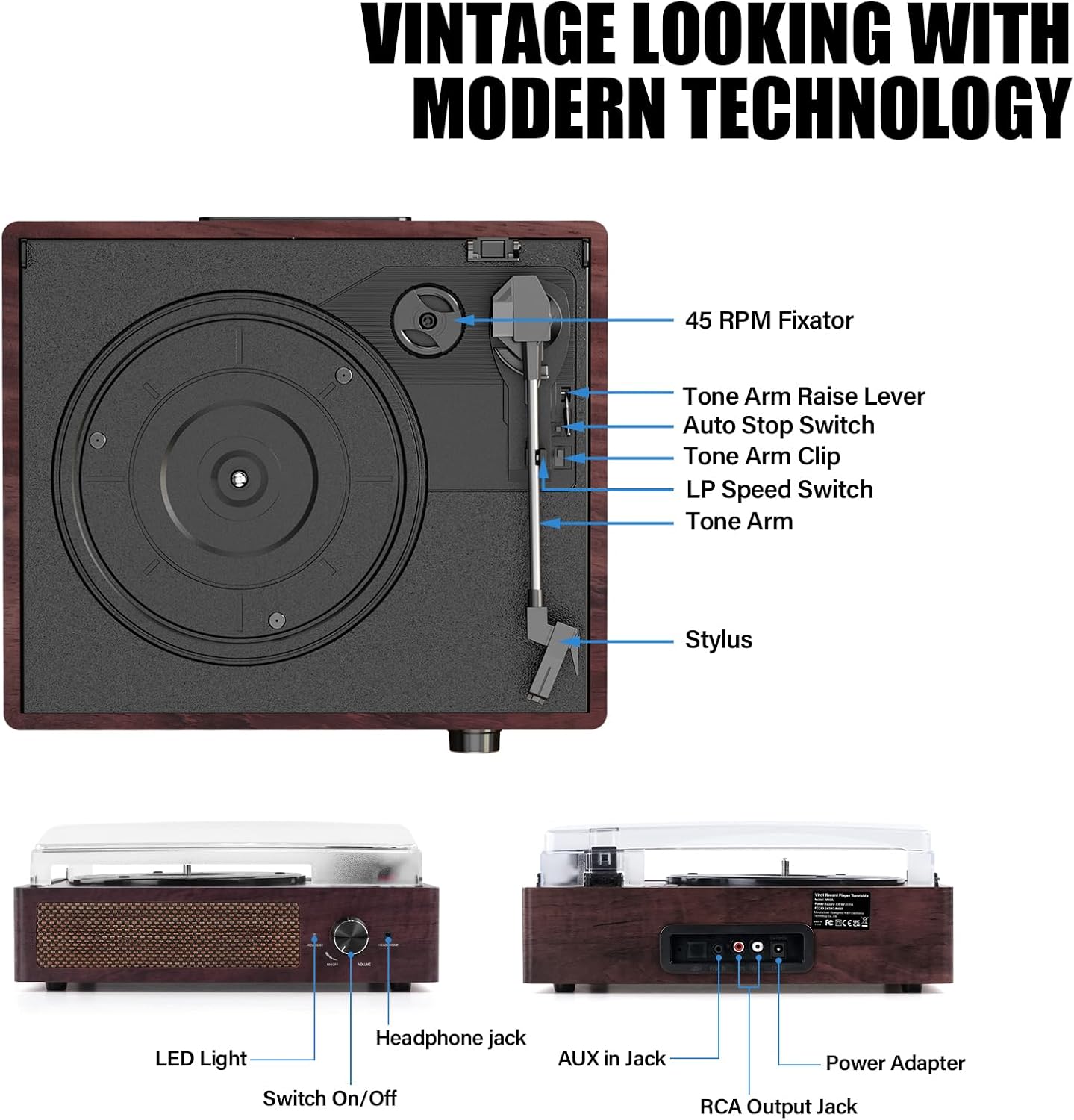
If you’ve been collecting vinyl for any length of time, you’ve probably noticed that records aren’t all pressed the same way — and your playback gear makes a real difference in how they sound. A turntable is the machine that plays your records: a spinning platter, a tonearm that holds a needle (called a cartridge), and a motor that keeps everything moving at the right speed. The two main motor setups you’ll encounter are belt drive (where a rubber belt spins the platter indirectly, absorbing vibration) and direct drive (where the motor connects straight to the platter, offering more torque and speed stability). For someone assembling a serious metal or hardcore vinyl collection — pressings that often run heavier in weight and louder in dynamic range than pop records — those engineering choices translate directly into how well your copy of a classic death metal record actually sounds. This guide will walk you through the tradeoffs that matter most, with real numbers and a clear decision framework at the end.
Belt Drive vs. Direct Drive: The Real Tradeoff for Heavy Pressings
The belt-drive-versus-direct-drive debate gets simplified to the point of uselessness in most beginner guides. Here’s the honest version for someone with real pressings on the shelf.
Belt drive isolates the motor’s vibration from the platter via a rubber belt. Because heavy music — death metal, doom, grindcore, powerviolence — features extreme dynamic swings, dense low-end, and aggressive transients, motor noise contaminating the stylus path is a legitimate concern. The Vinyl Factory’s overview of turntable mechanics notes that belt-drive systems have historically been the preference of audiophiles specifically because of their lower rumble (the technical term for motor-generated noise that the needle picks up). For a pressing like a 180-gram reissue from Nuclear Blast or a hand-numbered variant from Southern Lord, where you’re paying $40–$80 for a single record, that isolation matters.
Direct drive, meanwhile, offers superior speed consistency — a measurement called wow and flutter, which describes how much the rotation speed varies. Lower wow and flutter means pitch stays more stable during playback. For heavily distorted metal, slight pitch drift is less audible than it would be on acoustic music, but it still affects low-end tightness. Direct drive also recovers speed faster after the stylus drops, which is mostly a DJ consideration — but it’s worth knowing the origin of that design advantage.
The practical split for this audience:
- If your collection skews toward premium, limited-run pressings you’re buying to listen and archive, belt drive is the more defensible choice in the $300–$700 deck range.
- If you have a secondary use case (DJ practice, scratching, high-volume drop parties), direct drive earns its place.
- At entry-level price points ($150–$250), the difference between belt and direct is smaller than the difference between a quality cartridge and a cheap one — which brings us to the next section.
Cartridge Quality: The Variable That Changes Everything
Most mid-range turntables ship with a cartridge already installed. This is where a significant portion of buyers leave real money on the table.
A cartridge is the assembly at the end of the tonearm that holds the stylus (the needle that physically contacts the groove). The stylus tip shape, the cantilever material, and the cartridge’s compliance (how easily it flexes in response to the groove) all determine how faithfully it reads what’s in your record. Heavy music pressings — especially early-90s death metal originals, thick 180-gram reissues, and modern limited pressings cut loud and hot — tend to have wider, more aggressively cut grooves than typical pop mastering. A cartridge that can’t track those grooves accurately either distorts, misreads dynamics, or — worst case — physically damages the groove wall over repeated plays.
Analog Planet’s published cartridge compliance guides consistently identify tonearm effective mass as the variable most buyers ignore. Every tonearm has a published effective mass rating (in grams); every cartridge has a compliance rating. When these are mismatched — a high-compliance cartridge on a heavy tonearm, or a low-compliance cartridge on a light one — the resonance frequency of the system drifts out of the ideal 8–12 Hz range. Below that range, warped records and floor vibration cause audible low-frequency noise. Above it, you lose detail in the upper midrange — exactly where guitar bite and snare attack live on a metal record.
By the numbers:
| Compliance Range | Ideal Tonearm Mass | Common Pairing |
|---|---|---|
| High (25–35 µm/mN) | 8–12g effective mass | Budget/mid turntable arms |
| Medium (12–20 µm/mN) | 12–18g effective mass | Most upgradeable mid-range decks |
| Low (6–12 µm/mN) | 18–25g effective mass | Audiophile / vintage arms |
Most stocked cartridges on $200–$400 turntables fall into the medium compliance range — which is defensible but not optimal for the dynamic demands of metal. The Analog Planet guides recommend the Ortofon 2M Red (medium compliance, widely compatible) as a legitimate performance floor for serious listening, and the 2M Blue as a meaningful step up without requiring an arm change on most mid-range decks. Aggregate reviewer sentiment across audio publications consistently puts the 2M Blue as the cartridge where listening fatigue starts to meaningfully decrease on dense heavy recordings.
Platter Weight, Anti-Skate, and the Details That Separate $300 from $700
If you’re spending $80 on a colored vinyl variant and $40–$60 shipping it from a European distro, putting it on a $129 all-in-one turntable is a value mismatch — not necessarily because it sounds terrible, but because the mechanical tolerances leave room for damage your money can’t recover.
Platter mass matters for speed stability more than most spec sheets emphasize. A heavier platter stores more rotational energy (called rotational inertia), meaning it resists speed variations when the stylus drags in a dense groove passage. The Vinyl Factory’s setup guides note that platters under 500g are more susceptible to speed variation during loud passages — a real concern for high-cut metal masters. Most decks in the $400+ range ship with platters in the 700g–1.5kg range.
Anti-skate is the adjustment that counteracts the tonearm’s natural tendency to pull toward the center of the record — a force called skating. Most beginners never touch it; most intermediate collectors set it once and forget it. The issue is that skating force increases with groove complexity. On a record cut with extreme dynamic peaks — a breakdown, a blast beat passage, a doom record’s wall-of-sub-bass outro — under-corrected anti-skate causes the stylus to drag harder on the inner groove wall, producing distortion and accelerating groove wear. Consequence of Sound’s turntable buying guides and Pitchfork’s beginner vinyl guide both flag anti-skate as a frequently misunderstood variable. The practical step: use the anti-skate test tracks on a dedicated setup record (the Hi-Fi News Analogue Test LP is widely cited by audiophile reviewers) to set it properly after every cartridge swap.
Tracking force — the downward pressure the stylus exerts on the groove, measured in grams — should be dialed in with a dedicated stylus force gauge, not trusted to the deck’s built-in counterweight scale alone. Most MM (moving magnet) cartridges in the $50–$200 range track optimally between 1.5–2.5g. Running too light causes mistracking and distortion; running too heavy accelerates groove wear. Owners of decks in the $300–$700 range consistently report that adding a $20–$40 stylus force gauge is one of the highest-ROI setup improvements available.
The Upgrade Path Decision Framework
Here’s where practitioners need clear decision rules, because the turntable category has a specific trap: incremental upgrades sound compelling but have diminishing returns at specific price thresholds.
The $200–$300 entry zone: Decks like the Audio-Technica AT-LP120XUSB and similar direct-drive units in this range are defensible as first serious decks. Owners across aggregated reviews report adequate performance with the stock cartridge for general listening. The limitation is the stock cartridge quality — upgrading to an Ortofon 2M Red at this tier delivers a noticeable improvement and is widely recommended as the first upgrade move. Total cost: ~$280–$320 all-in.
The $400–$600 mid-range: This is where belt-drive options become genuinely competitive. Decks like the Pro-Ject Debut Carbon EVO ship with a cartridge that reviewers at The Vinyl Factory and Analog Planet consistently rate as matched to the arm — meaning you’re not immediately spending more to fix a mismatch. The platter mass and bearing quality at this tier is meaningfully better, which matters if your collection includes significant quantities of older pressings (pre-1990 originals) or modern high-cut reissues.
The $700–$1,200 serious collector tier: At this level you’re buying for longevity and archival fidelity. Decks in this range (Rega Planar 3, Pro-Ject X2, comparable options) offer upgrade paths for the tonearm and cartridge without replacing the entire platform. For someone managing a collection that includes test pressings, hand-numbered box sets, and tour-exclusive variants in the $100–$300+ per release tier, the math favors a platform you can improve incrementally over a replaced-every-few-years budget deck.
The decision rule:
- If your average record cost is under $30 and your collection is under 200 records: spend $280–$320 on a mid-range direct-drive unit with a cartridge upgrade.
- If your average record cost is $40–$80 and you’re adding 10+ serious pressings per month: the $400–$600 belt-drive tier is where the math starts to justify itself in both sound quality and reduced groove wear risk.
- If you’re buying test pressings, tour-exclusives, or variants above $100, treat the turntable as archival infrastructure. The $700–$1,200 tier isn’t audiophile luxury — it’s risk management on an appreciating asset.
- If a cartridge/arm compliance mismatch exists in your current setup: fix that first, before upgrading the deck. A $100 cartridge swap on a mismatched arm often delivers less improvement than a properly matched stock cartridge.
The gear should serve the collection, not the other way around. Heavy music presses loud, cuts wide, and rewards setups that can actually read what’s in the groove — which means the decisions you make at the tonearm end of your system matter as much as the platter under it.